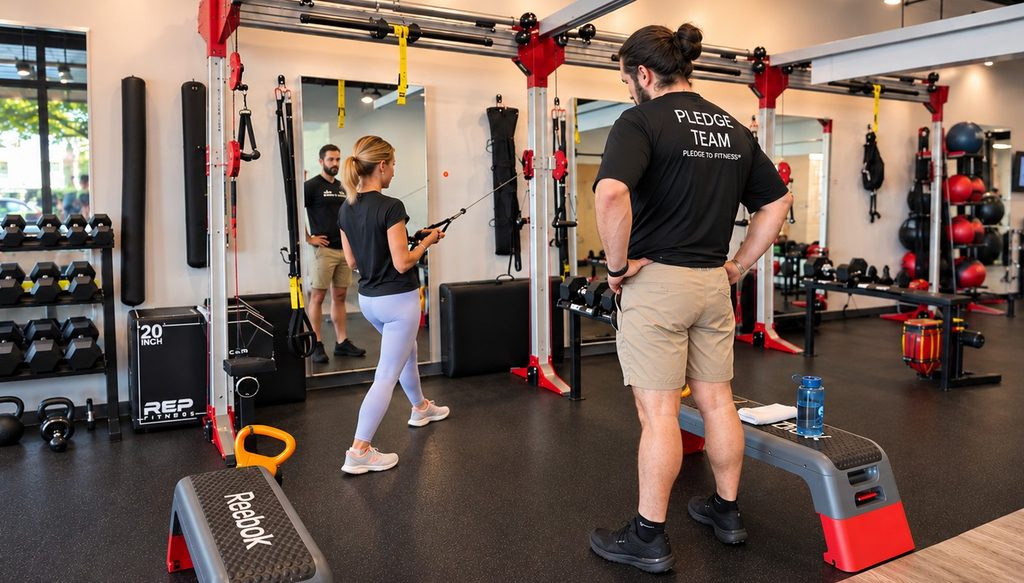
What personal trainers do during a workout can vary considerably. How a trainer works depends on their training philosophy and methodology, as well as your goals, abilities, experience, and individual needs.
Some trainers may focus primarily on the workout itself—selecting exercises, monitoring form, and progressing weight or intensity. Others take a broader approach, looking at how movement quality, strength, nutrition, recovery, body composition, and your goals interact over time.
At Pledge To Fitness® in Bellaire, coaches use an integrated, assessment-driven approach to personal training. Your trainer is constantly watching how you move: where you compensate, when fatigue changes your mechanics, whether an exercise fits your body, and when you are ready to progress. Even if you are fit and experienced, a trainer may identify movement patterns or weak points you have never noticed. That ability to observe, interpret, and adjust your training is an important part of what makes personal training truly personal.
What Personal Trainers Do During a Workout
During a workout, your trainer is constantly gathering information.
A trainer looks at movement quality, balance, control, posture, fatigue, and how one movement relates to another. Those observations help determine whether you should add weight, reduce it, change the number of repetitions, allow more recovery, modify an exercise, or choose something different.
The important question is not simply, Can you perform the exercise? It is How are you performing it?
At Pledge To Fitness®, this ongoing assessment helps your coach adapt the training to you rather than expecting you to adapt to a predetermined workout.
A Personal Trainer Evaluates How You Move
Movement assessment is an established component of professional fitness training, as explained by the American Council on Exercise. Personal trainers evaluate your overall movement competency—how well you understand and control your body through different movements.
Strength and movement quality are not always the same thing. You may be very strong, for example, but consistently shift your weight toward the balls of your feet during a squat, placing unnecessary stress on your knees. It may seem like a small detail, but it can become more significant as weight, intensity, or training volume increases.
A trainer also looks at the relationship between different movements.
You might have an excellent squat, with strong quads and great posture, but struggle significantly with a deadlift. That difference can point toward comparatively weaker hamstrings, glutes, or posterior-chain control. It may even provide useful context for recurring low-back discomfort or tightness around the front of the hip.
During squats and lunges, your trainer may notice that you shift onto your toes, allow a knee to collapse inward, or favor one side. During pushing and pulling movements, the trainer is watching your shoulders, shoulder blades, trunk, and spine—not just whether you can move the weight from point A to point B.
These small patterns are part of what personal trainers do well: notice relationships that can point to what needs attention next.
A Personal Trainer Adapts Exercises to Your Body
An exercise can be appropriate on paper and still not be right for you. Pain, pinching, compensation, or loss of good mechanics can signal that something needs to change.
A shoulder press, for example, may feel uncomfortable with your arms directly out to the sides. Moving slightly forward into the scapular plane, or scaption, may improve both comfort and mechanics.
Squat depth is another example. If your position begins to deteriorate below a certain depth, there is no reason to force the movement simply because a textbook says a squat should look a certain way.
The exercise should fit you—not the other way around.
Sometimes Progress Means Taking a Step Back
Progress does not always mean adding weight or making an exercise harder.
Fatigue may cause your form to break down even when the primary muscles still feel strong. Your trainer may respond by reducing the weight, lowering the repetitions, increasing rest, or changing the exercise.
The goal is not simply to make you tired. It is to create enough challenge to produce an adaptation while maintaining good movement quality.
The same principle applies when a client is accustomed to lifting heavy weights but lacks the stability or control to manage them well. Returning to a simpler variation—such as mastering a basic push-up before advancing—can build the foundation needed for better progress later.
Making an exercise easier is not necessarily a regression.
Knowing When You Are Ready to Progress
A trainer also watches for the opposite: when you are ready for more.
Consistent form, control, and confidence can signal that it is time to increase the challenge. Your trainer can then adjust the weight, exercise, or progression while maintaining good mechanics.
The American College of Sports Medicine’s 2026 resistance training guidelines emphasize tailoring training programs to individual goals and capabilities.
This principle is built into the Pledge System™, which progresses through Stability, Endurance, Hypertrophy, and Strength. The phases provide structure, but progression is not based simply on time. What your trainer observes helps determine what your body is ready for next.
A Personal Trainer Helps You See Progress You May Miss
Progress can be difficult to recognize when you see yourself every day. Changes in strength, movement, confidence, or body composition often happen gradually.
At Pledge To Fitness®, coaches often look at progress in terms of “threes”: what has changed over three weeks and what has changed over three months.
Your goals may also evolve. You may begin focused on weight loss and discover that what matters more is improving body composition, building muscle, or simply getting stronger.
Tools such as the Fit3D body scanner can help make those changes visible when the scale does not.
A trainer provides something else as well: perspective. When you are focused on what still needs improvement, it helps to have someone who can remind you how far you have already come.
What Personal Trainers Do That You May Not Notice
What personal trainers do is connect patterns you may miss—how strength affects movement, how fatigue changes form, and when you are ready to progress. At Pledge To Fitness®, thus is part of an ongoing process of assessing, adapting, and progressing your training.
Andres Loperena, founder of Pledge To Fitness®, compares it to an experienced mechanic.
“It’s a lot like what an experienced mechanic sees when they look at your car—small signs, patterns, and relationships that may mean nothing to you but tell them exactly where to look and what needs attention.”
In the same way, an experienced trainer knows what to look for, what it means, and how to use that knowledge to guide your training.
See What Personalized Training Can Do for You
Your training should fit your body, your goals, and where you are today. Schedule a free assessment with the Pledge To Fitness Team® and discover how an individualized approach can help you move, train, and progress with confidence.